
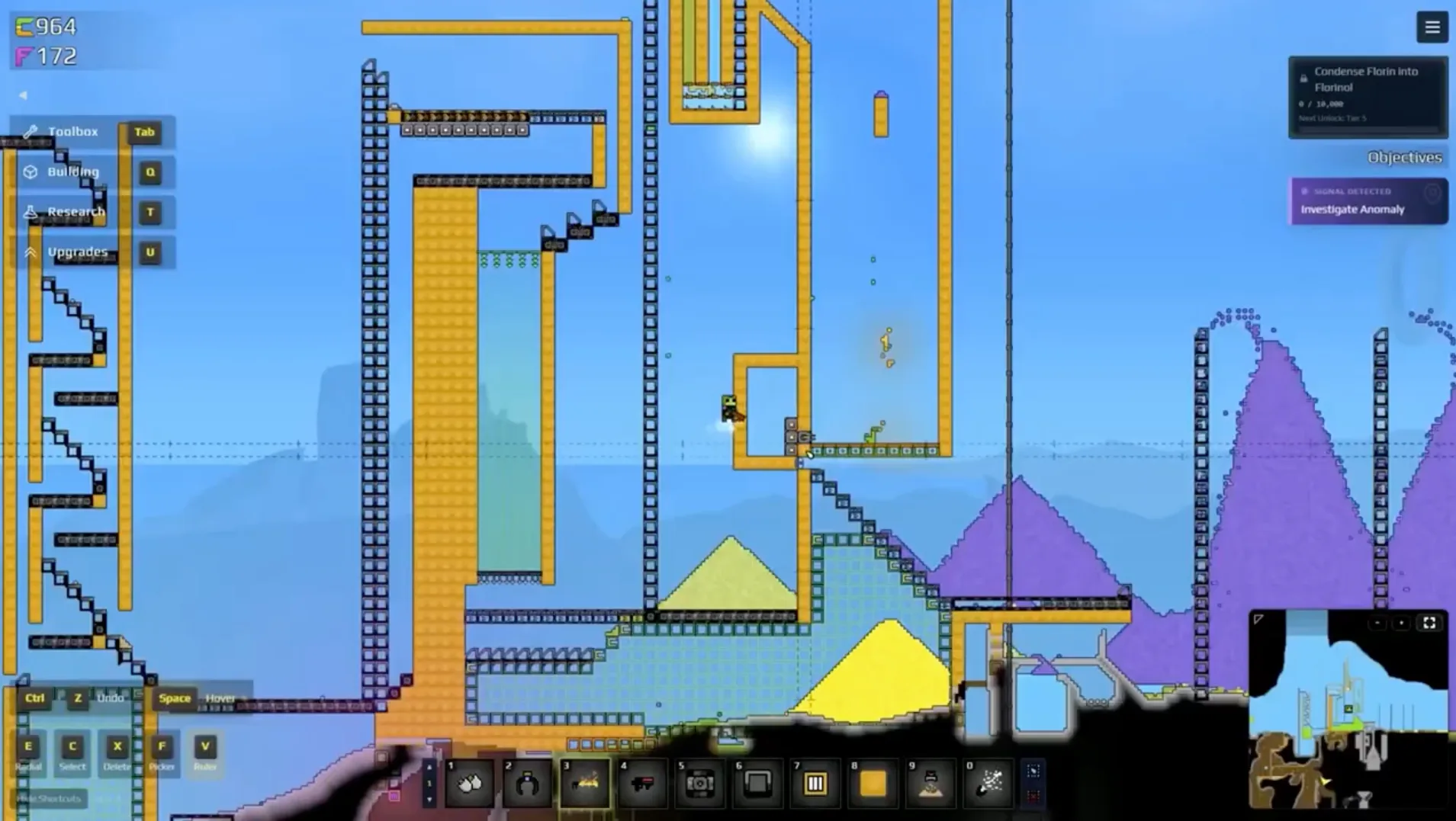
The Sandustry Core Loop
Every session follows the same backbone: dig sand, add water to make wet sand, run it through a Shaker to get gold, spend gold on research, unlock new buildings and logistics, then use those to build bigger production chains and dig deeper underground. The loop is simple to state and deep to master, because every stage feeds the next and every machine introduces a new material to manage.
What makes the loop feel different from other automation games is that the materials are physical. Wet sand isn't an inventory icon - it's wet pixels that pile, flow and drip. Gold sifted from a shaker falls and settles at the bottom of a pile because it's the densest thing there. The core mechanics of Sandustry are the physics.
Sandustry Three Currencies, Three Economies
- Gold - the research currency. Everything you unlock - shakers, conveyors, launchers, filters, presses - is bought with gold.
- Fluxite (purple) - the upgrade currency, spent on improving your inventory items: the grabber, weapons and drones.
- Energy - the late-game power currency, refined from specific materials and required by advanced structures like the synthesizer.
The three rarely compete for the same input, but they do compete for your attention. Gold stops being scarce once a couple of presses are running; the trick players learn early is to keep spending it - infrastructure bought now compounds faster than a pile of gold saved for later. Fluxite tends to become the practical bottleneck for tool upgrades, and energy becomes the goal of the deepest production chains.
Sandustry Research & Factory Level Mechanics
Research is the progression system: a tree of unlocks bought with gold. It doesn't unlock linearly, though - advanced research is gated behind your Factory Level, a tier system that advances when you hit milestones set by the "supervisor" above you. Hit a tier, and a new shelf of the tree opens.
The opening order that works for most runs: Refining first (it unlocks the Shaker, which is how gold exists at all), then Logistics (Conveyor Belts and Launchers, which are how gold gets anywhere), with Filters and Pipes shortly after. From there the tree fans out into processing machines, weapons and digging tools. The deeper tiers - smelters, synthesizers, the energy chain - only matter once your factory is feeding itself, and they're covered in the copper and materials guide.
Sandustry Production & Refining Mechanics
Resources refine through multiple stages, and the key machines are the thermal structures: heat structures turn solids into liquids into gases, cold structures do the reverse. Temperature is a production tool, not decoration - the same pile of material can be frozen, melted or vaporized depending on which chain you're feeding.
Gold itself comes from three structures: the Shaker (sifts wet sand, probabilistic yield), the Kinetic Slag Press (crushes burnt slag into gold and spores - deterministic, and the early workhorse) and the Planter Box (grows seeds into flowers). The press has its own full guide; the short version is that slag, the "waste" from shakers, becomes fuel for the most reliable gold source in the first hours.
Sandustry Logistics & Automation Mechanics
Conveyor belts move solids horizontally, and launchers throw them vertically or diagonally - together they cover every direction a factory grows. Filters sort mixed piles by allowing or blocking a single material, and since every material has a density, gravity does half the sorting before a filter even sees the pile: the lightest float, gold sinks, and same-density materials line up in stable layers.
Two mechanics decide whether a factory hums or jams: filters move at fixed belt speed (a faster belt before a slow filter changes nothing), and grabbers carry one material at a time (which is a bug early and a feature later - it's a free sorting step). None of the core logistics structures need power, which keeps early automation forgiving. The tips guide collects the practical shortcuts.
Sandustry Core Exploration: Destructible World, Ruins & Artifacts
The other half of Sandustry is the planet itself. The world is destructible down to individual pixels - you can dig, redirect rivers, drain lakes into your factory, and strip-mine nearly the entire map if you want to. The exceptions are bedrock at the map's floor and a few materials that need specific tools (some ore walls shrug off everything short of a drill or laser).
Below the surface the game changes character: caves, lava chambers, ancient portals and the ruins of a civilization that came before you. The developer has confirmed the design - fight bosses and solve puzzles in ancient structures to acquire key items and artifacts - and the game's own pitch is that hunting artifacts is one of the three viable ways to spend your early resources, alongside processing and logistics. Artifacts found while exploring enhance your progression, and some achievements (Ancient Technology among them) are tied to what the ruins contain.
Honest limits of current knowledge: the game launched into Early Access on August 13, 2026, and as of this guide's last update there is no complete, verified catalog of every artifact, ruin location or puzzle solution - the official wiki doesn't document them yet, and we won't invent one. What's confirmed is the structure: ruins exist, they guard key items, bosses and puzzles gate them, and exploration is a first-class progression path rather than scenery. A minimap tracks objectives with yellow arrows when something needs your attention off-screen.
The surface world matters too: steam vents condense into rain, water pools in low ground, and seed randomness affects where lakes and sand fields spawn - so scouting a map before committing to a base spot is a real skill, not a formality.
Sandustry Quick Balance Reference
From the official wiki's materials chart, a rough overall planning ratio is 2 sand : 3 water : 4 red sand -> 3 gold : 8 fluxite. Yields vary - gold is probabilistic at the Shaker stage, deterministic later - so treat it as a planning aid, not a promise. For what's known about the late-game materials beyond this chart (copper, florin, the energy chain), see the materials guide.